A hospital emergency plan can assign responsibilities, but it cannot make decisions. Whether a hospital remains operational during a major incident depends on how quickly fragmented reports become a shared operating picture, assessments become tasks, and tasks produce verifiable results. Recent studies suggest that a gap persists between written preparedness and command capability in practice.

A plan is not a command system
During the first thirty minutes of a hospital alert, telephones ring, the emergency department reports initial casualty numbers, wards request staff, and technical services ask what to prioritise. Several different figures for available beds may appear on the whiteboard. No one need have made a serious mistake, yet the incident command team may still lack the single overview it needs to act. Mass-casualty incidents, cyberattacks, power failures and evacuations have different causes but pose the same command challenge: collect information, interpret it, set priorities, act, and verify the outcome.
Hospital emergency and incident planning (Krankenhausalarm- und Einsatzplanung, KAEP) is now an established responsibility. In 2020, Germany’s Federal Office of Civil Protection and Disaster Assistance (BBK) published a comprehensive practice manual [1]. In a survey conducted in Baden-Württemberg in 2019, 135 of 214 hospitals responded; 134 respondents reported having an emergency plan. Only 37% reported conducting incident command exercises, however, and in almost one quarter the last exercise had taken place more than five years earlier or none had ever been held [2]. These are regional, older findings, but they illustrate the difference between having a plan and using it.
More recent evidence points to considerable variation in implementation. A nationwide online survey conducted in 2022–2023 and published in 2026 received 72 fully completed questionnaires. Among respondents, 47% used incident command structures based on German Fire Service Regulation 100 (FwDV 100), while 67% reported exercising only rarely or never [3]. The sample was small and cannot be considered representative. It does not support extrapolation to all German hospitals; nevertheless, it highlights an organisational issue: the existence of a plan does not establish an exercised command capability.
Command is a process, not an organisational chart
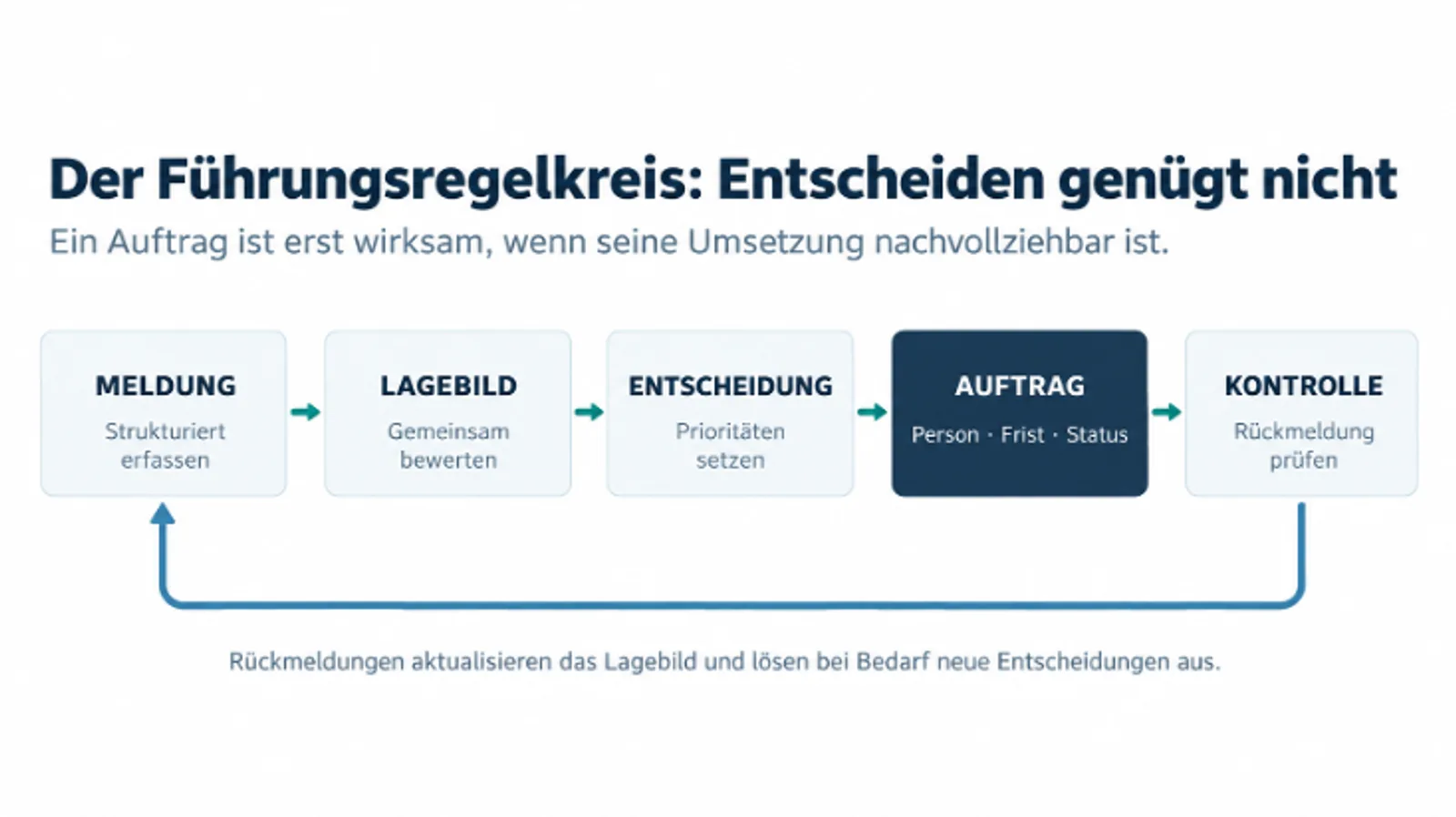
German fire and civil protection services have a well-established command framework in FwDV 100. It describes a cycle of situation assessment, planning, decision-making, issuing orders and checking their execution. Incoming feedback starts the cycle again [5]. The staff structure provides the framework, but what matters in practice is a predictable reporting pathway, explicit responsibility, a documented decision status, and confirmation that instructions have been carried out.
A qualitative study from Heidelberg, published in July 2026, demonstrates the relevance of these issues within hospitals. Nineteen participants were studied following a hospital incident command tabletop exercise. Reported barriers included unclear roles, fragmented communication, weak prioritisation, and personnel or infrastructure constraints. Clear role allocation, structured communication, phased decision-making and regular exercises were identified as enabling factors [4]. This was not a representative effectiveness trial, but it offers a focused view of how hospital incident command functions in practice.
At a hospital incident command meeting, executive management, medical leadership, nursing management, technical services and administration work alongside one another. They have substantial specialist expertise but not necessarily routine in incident command. The command process must therefore remain intelligible and robust under pressure, including for staff who assume these duties only occasionally.
Three levels, one operating picture
A hospital is not commanded solely from its incident command room. The operational situation develops in the emergency department, intensive care units, operating theatres, clinical departments and infrastructure services. In a mass-casualty incident, triage establishes clinical categories and anticipated treatment needs. Operational medical coordination, for example a central operational emergency coordinator (ZONK), prioritises and allocates clinical measures. Hospital incident command (Krankenhauseinsatzleitung, KEL) evaluates implications for the organisation as a whole, sets objectives and makes overarching decisions. Job titles and responsibilities must, however, follow each hospital’s own emergency plan.
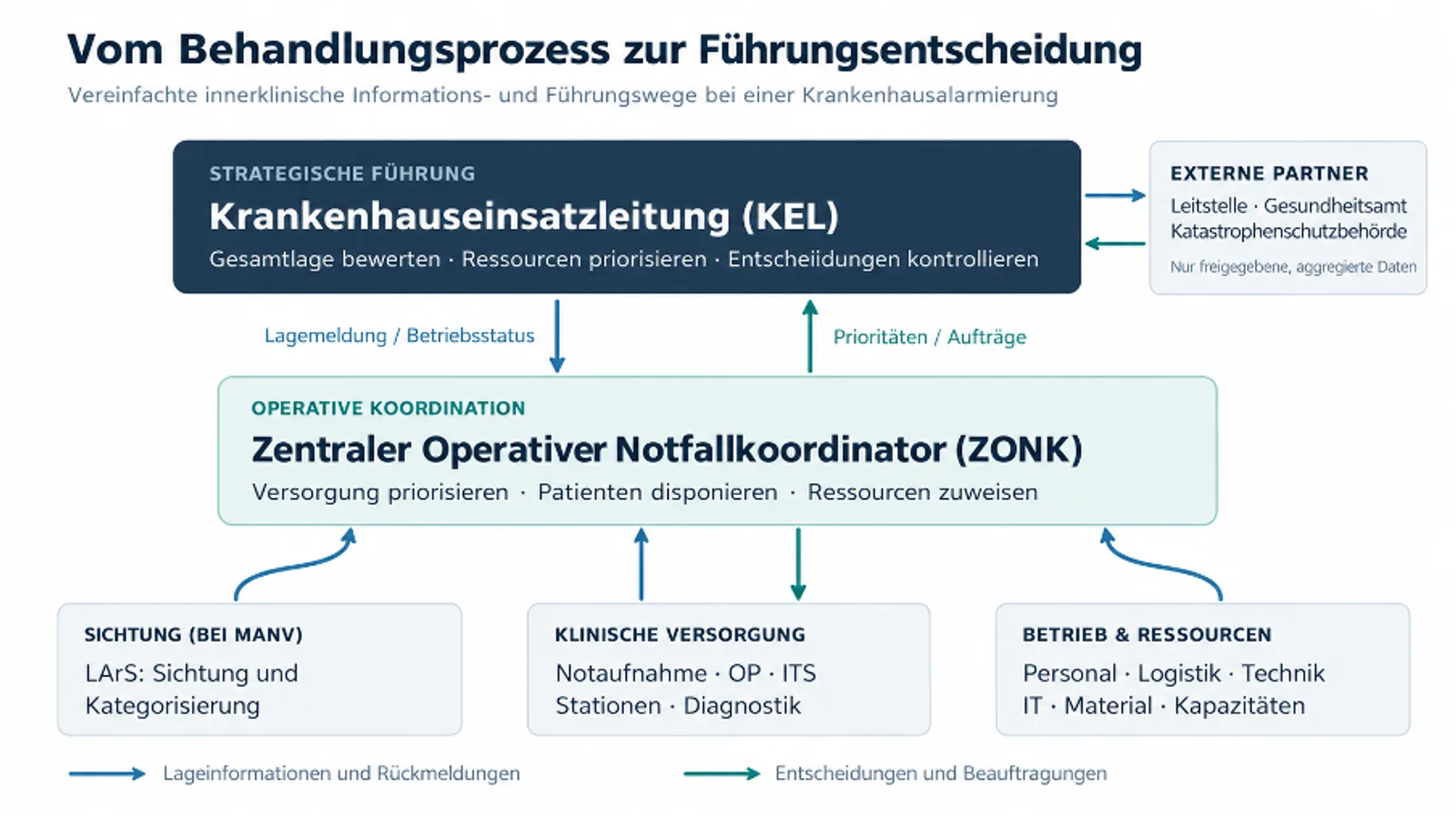
A familiar point of failure occurs when the same figures are requested repeatedly: at triage, by telephone during operating-room coordination, and once again for the next situation briefing. Instead of parallel lists, hospitals need defined reporting fields, identifiable data sources and time stamps. The same information can then be displayed according to role: in clinical detail at the point of care, as actionable allocation data at the operational level, and in consolidated form for hospital incident command. A shared operating picture does not require unrestricted access to all information. It requires a consistent information base.
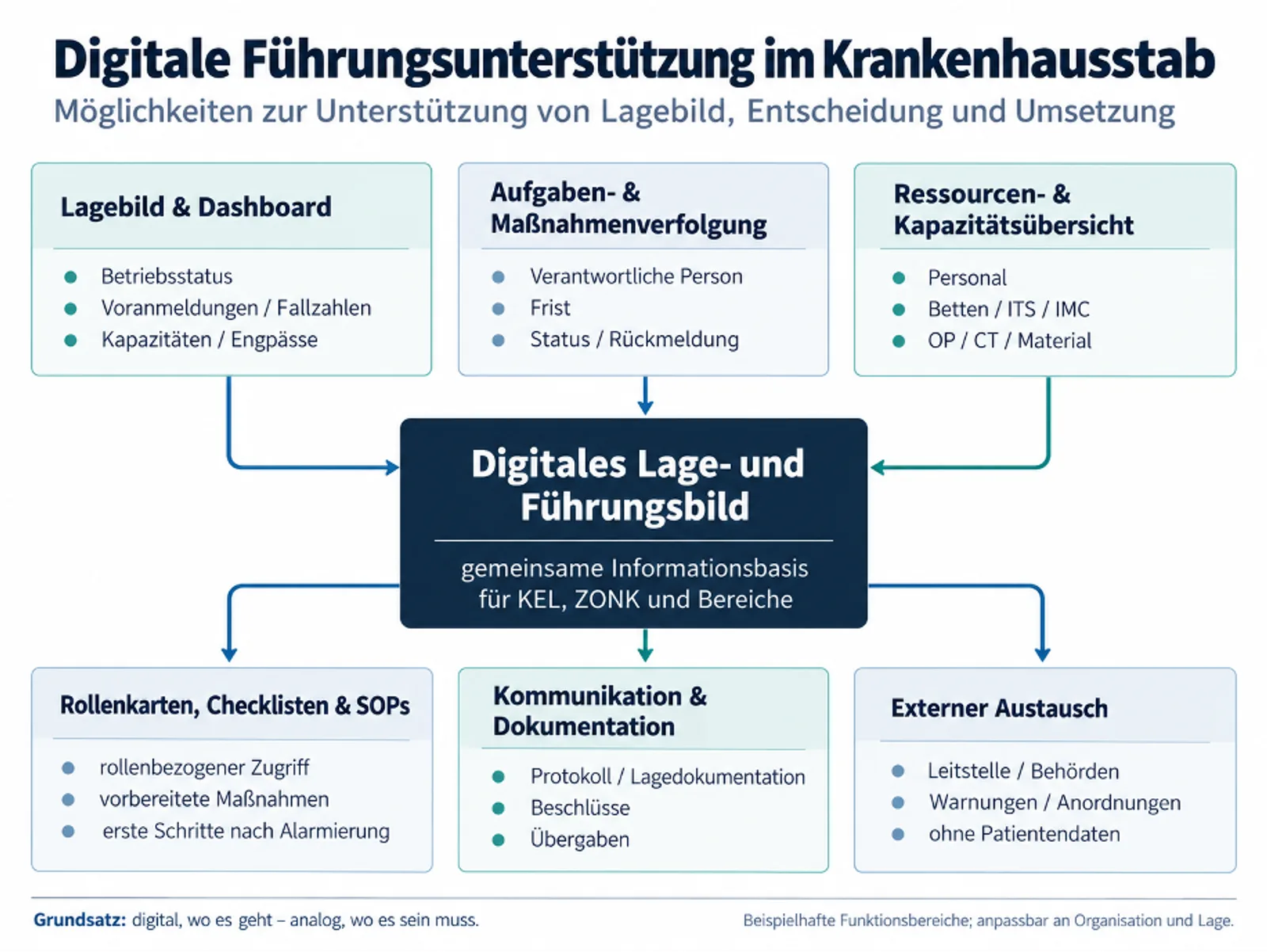
This is a practical use case for digital command support: structured situation reports, dashboards showing operational status and constraints, role-based views, recorded decisions and feedback. Software does not make the decision; it organises the information flow and makes its current status auditable.
An empty bed is not necessarily treatment capacity
The number of unoccupied beds is a poor proxy for actual treatment capability. An intensive care bed without appropriately trained staff or oxygen supply is not an operational critical-care place. Opening an additional operating theatre requires not only a room and equipment, but anaesthesia, surgical and nursing teams, supplies and downstream recovery or critical-care capacity.
The literature on surge capacity captures these dependencies in four components: staff, stuff, structure and systems [6]. The CO-S-TR model adds a practical initial assessment of command and communications, logistics, and patient tracking and treatment [7]. For hospital leadership, this means reporting capacity in terms of actual usability, clinical capability and timing. A single figure for “available beds” is inadequate.
Digital resource overviews can help link capacity to constraints: available operating teams, critical-care nursing staff, CT access, blood products, medical technology and essential supplies. Technical interfaces are useful where their data are reliable. Where integration is absent, or unavailable during a cyber incident, staff must be able to submit manual, time-stamped updates. An attractive dashboard does not turn poor data into valid information.
From a checklist item to a completed task
Following activation, staff should have immediate access to role cards, initial actions and priorities. Digital role cards and checklists can help. Command, however, starts when these instructions become specific tasks: Who does what, by when? Who acknowledges the assignment? What is its status, and how does the result change the operating picture?
Task tracking closes the command loop. Actions can be assigned to defined functions, prioritised and followed across briefings and shift changes. For example, reporting that additional staff have been “called in” is insufficient. Command needs to know whether they have arrived, registered, received an assignment and become operational. The same logic applies to requests for supplies, patient transfers and technical work.
I experienced how quickly this overview can disappear while working in a command staff during the 2021 Ahr Valley floods. Requests came from operational sectors and staging areas by email, without a continuously visible processing status. After a handover, it was often unclear what had been ordered, completed or remained open. This is not a problem unique to hospitals, but in a hospital such gaps can directly affect patient care. An email inbox is not a task-tracking system.
Digital support requires analogue fallback procedures
A digital command tool can bring together situation reporting, action tracking, resource overviews, communication, documentation and structured exchange with external agencies. This does not mean every process should be digitised, nor does it establish that a given platform improves clinical outcomes. A 2024 systematic review of information and communication technology for mass-casualty management identified only 15 eligible studies and emphasised the limited experimental evidence [12]. Another systematic review of disaster situational awareness highlighted persistent gaps in communication, data processing and interoperability [13]. These findings support further development and evaluation, rather than proving the effectiveness of individual products.
Dependence on digital infrastructure must itself be included in the risk assessment. Relevant system requirements include accessibility when the hospital network fails, reliable authentication, granular permissions, secure data exchange, redundancy, auditable records and tested recovery procedures. External hosting does not automatically guarantee continuity: network connectivity, end-user devices and identity services may fail as well.
Every hospital therefore also needs rehearsed analogue procedures: printed role cards, standardised reporting forms, situation boards, alternative telephone or radio arrangements and a defined process for re-entering information once digital systems recover. Digital where it provides a clear organisational benefit; analogue where it is needed for continuity. In either case, responsibility remains with the people in command.
The operating picture does not stop at the hospital gate
For emergency dispatch centres, public health authorities and civil protection agencies, hospital command capability is not purely an internal matter. They need to know whether a hospital can accept patients, which services are restricted, and when assistance is needed. Systems such as IVENA and Germany’s DIVI intensive care registry demonstrate the feasibility of structured capacity reporting. They do not, however, replace a comprehensive operational and capability picture for an entire hospital.
The strategic importance of this issue is growing as Germany prepares for collective and national defence. In October 2025, the German Hospital Federation (Deutsche Krankenhausgesellschaft, DKG) called for a national hospital resilience strategy. A DKG-commissioned assessment by hcb and the German Hospital Institute estimated investment requirements of approximately €2.7 billion to €15 billion across different crisis scenarios and identified shortcomings in workforce preparation, cyber security and communications resilience, among other areas [9, 10]. Crucially, the assessment argues that planning cannot stop at acute-care hospitals. Rehabilitation, nursing care, psychiatric care and office-based medical services form part of the patient pathway and must be included in crisis planning [10].
A paper by Heller and colleagues, published on 15 October 2026, sets out more specific requirements for civil–military patient allocation. It calls for a digital common operating picture of healthcare capacity and capabilities, interoperable procedures, and coordination between national, supraregional, regional and hospital levels [11]. The authors also note that bed-occupancy figures transmitted once per day may fail to capture the capacity actually available in rapidly changing circumstances. This is a proposed operational architecture, not evidence that a fully integrated national system is already operational.
The implication for individual hospitals is straightforward: a hospital must be able to produce a structured picture of its own situation before it can reliably report to external partners. A useful approach would be a minimal, agreed set of reports on operational status, treatment capabilities, restrictions and support requirements. Regional coordination bodies could consolidate these data and, when appropriate, transmit them to higher levels. National patient-flow planning would ultimately also need to consider rehabilitation and ambulatory follow-up care. Which agencies receive which data, and who has the legal power to direct patient allocations, are questions of governance and law, not software features.
Four actions hospitals can take now
First, establish mandatory situation reports. Relevant departments should report using a standard template at an agreed interval; during a rapidly evolving initial phase, this could be every 30 minutes. Each report needs a timestamp, a source, and an explicit statement of availability or impairment.
Second, do not issue a task without assigning ownership and requiring feedback. Each action needs a responsible function, priority, deadline and visible status. Completing a task should trigger a report of its actual result and an update to the operating picture.
Third, rehearse the first thirty minutes regularly. Alerting, taking up command roles, initial situation assessment and task assignment can be trained in short, repeatable tabletop sequences. A 2026 Heidelberg mass-casualty simulation involving 91 simulated casualties also demonstrates how performance can be evaluated using objective triage, workload and patient-flow measures [8].
Fourth, agree information exchange arrangements in advance. Hospitals, dispatch centres and responsible authorities should establish which small set of indicators they actually need, how current these data must be, and how reporting will continue during an IT outage. The number of interfaces matters less than whether the information is usable when decisions are due.
Conclusion
The central question is no longer simply whether a hospital can produce an up-to-date emergency plan. It is how quickly that plan can become a functioning command organisation, whether decisions can be followed through, and whether the resulting operating picture can be shared beyond the hospital. Digital command support can be an important working tool. It cannot replace clearly defined roles, exercises or robust reporting procedures. Its purpose is to support those foundations, including when an incident lasts longer than the first shift.
About the author
Fabian Schmidt is a physician specialising in anaesthesiology and emergency medicine and works as an emergency physician. He teaches hospital emergency and incident planning at Akkon University of Human Sciences in Berlin.
Declaration of interests
The author founded Notfallakademie UG, which provides crisis management consultancy and exercises and develops digital incident command support. This article does not evaluate any specific software product and reflects the author’s professional views.
References
[1] Bundesamt für Bevölkerungsschutz und Katastrophenhilfe (BBK) (2020). Handbuch Krankenhausalarm- und -einsatzplanung (KAEP). Bonn.
https://www.bbk.bund.de/SharedDocs/Downloads/DE/Mediathek/Publikationen/Gesundheit/KAEP/handbuch-kaep.pdf?__blob=publicationFile
[2] Pfenninger EG, Villhauer S, Königsdorfer M (2022, online; print 2025). Krankenhausalarm- und -einsatzplanung in Baden-Württemberg. Eine länderspezifische Umfrage an 214 Kliniken. Notfall Rettungsmed.
https://doi.org/10.1007/s10049-022-01065-1
[3] Geiger M, Neuner S, Bodur ME, Fekete A (2026). Ausfall kritischer Infrastrukturen in deutschen Krankenhäusern: Onlineumfrage zu Krisenstabsstrukturen und Übungen in Krankenhäusern. Die Anaesthesiologie 75:391–398.
https://doi.org/10.1007/s00101-026-01664-4
[4] Ries M, von der Forst M, Schäfer H et al. (2026). Operational enablers and barriers in hospital incident command: insights from a single-center table-top exercise at a tertiary care university hospital—a qualitative phenomenological study. Front Public Health 14:1880835.
https://doi.org/10.3389/fpubh.2026.1880835
[5] Feuerwehr-Dienstvorschrift 100 (FwDV 100) (1999). Führung und Leitung im Einsatz: Führungssystem. Stand 10. März 1999.
https://www.lfs-bw.de/themen/gesetzevorschriften/fwdv/
[6] Barbisch DF, Koenig KL (2006). Understanding surge capacity: essential elements. Acad Emerg Med 13(11):1098–1102.
https://doi.org/10.1197/j.aem.2006.06.041
[7] Hick JL, Koenig KL, Barbisch D, Bey TA (2008). Surge capacity concepts for health care facilities: the CO-S-TR model for initial incident assessment. Disaster Med Public Health Prep 2(Suppl 1):S51–S57.
https://doi.org/10.1097/DMP.0b013e31817fffe8
[8] von der Forst M, Schaefer H, Mohr S et al. (2026). Improving preparedness for mass casualty incidents in hospitals: insights from a large-scale simulation exercise with geotracking and validated questionnaires. BMC Emerg Med 26:97.
https://doi.org/10.1186/s12873-026-01527-6
[9] Deutsche Krankenhausgesellschaft (DKG) (28.10.2025). Krankenhäuser müssen krisentauglich werden – DKG fordert nationale Strategie zur Stärkung der Resilienz. Pressemitteilung.
https://www.dkgev.de/dkg/presse/details/dkg-stellt-gutachten-vor/
[10] Augurzky B, Blum K, Heber R, Offermanns M, Parloh AK, Pilny A, Reuter J (2025). Investitionsbedarfe zur Herstellung der Resilienz deutscher Krankenhäuser. Endbericht für die DKG, hcb/DKI, 28. Oktober 2025; insbesondere S. 42–44.
https://www.dki.de/fileadmin/user_upload/2025-11-07_DKG_Resilienz_final_formatiert.pdf
[11] Heller AR, Franke A, Brüne F, Ritter DM, Wurmb T (2026). Patientensteuerung vom Aufkommensort bis ins Krankenhaus: Militärisch-zivile Schnittstelle, Clustersteuerung und Krankenhauskoordinierung. Notfall Rettungsmed (online 15.10.2026).
https://doi.org/10.1007/s10049-026-01828-0
[12] Režek P, Žvanut B (2024). Towards optimal decision making in mass casualty incidents management through ICT: a systematic review. Int J Disaster Risk Reduct 102:104281.
https://doi.org/10.1016/j.ijdrr.2024.104281
[13] Kedia T, Ratcliff J, O’Connor M, Oluic S, Rose M, Freeman J, Rainwater-Lovett K (2020). Technologies enabling situational awareness during disaster response: a systematic review. Disaster Med Public Health Prep.
https://doi.org/10.1017/dmp.2020.196
Mit WhatsApp immer auf dem neuesten Stand bleiben!