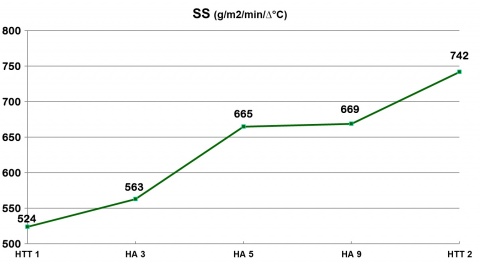
Fig. 2: Heat Acclimation Adaptations – Sweat Mechanisms (SS =
sweat sensitivity; HA = heat acclimation; HTT = Heat Tolerance Test)
sweat sensitivity; HA = heat acclimation; HTT = Heat Tolerance Test)
Background: Protective clothing and gear restrict heat dissipation during military operations in both hot and cool environments placing military personnel at an elevated risk for heat injury/illness. Fairly complex and expensive technologies are employed to address this problem, however, heat acclimation (HA), an intervention occasionally used in athletics, is not often considered in military operations and training.
Discussion: Well known HA-induced physiological adaptations are, temporally, cardiovascular changes followed by enhanced sweat mechanisms resulting in reduced thermoregulatory strain. However, HA may be of little or no use in military operations as these adaptations, namely enhanced sweat mechanisms, are restricted by required military clothing and gear. The US Air Force conducted thermal stress research to explore if HA was efficacious for addressing thermal strain in military operations. We measured thermal stress in subjects exercising in warm-humid conditions while wearing the bulky, heat transfer restricting US Air Force Chemical Defense Ensemble (CDE) prior to and after ten days of hot-humid HA. Heat balance equations showed that HA elicited significantly lower thermal stress during exercise in the CDE, this result was not due to enhanced heat dissipation mechanisms, rather due to reduced metabolic heat production. Finally, we provide applied physiology recommendations to elicit a state of HA in military personnel prior to conducting operations in varied climate conditions.

Conclusion: Due to its effect on exercise metabolic rate HA may offer a low cost methodology for attenuating heat injury risk and concomitantly enhancing human performance in military members wearing semi-permeable or non-permeable clothing in both cool and hot environments
Keywords: heat acclimation, heat acclimatization, exercise, human performance, military operations
Hintergrund: Schutzbekleidung und -ausrüstung behindern die Wärmabgabe und erhöhen bei Einsätzen sowohl in heißer wie in kalter Umgebung das Risiko für hitzestressinduzierte Erkrankungen. Zur Lösung dieses Problems wurden komplexe und kostenaufwändige Technologien entwickelt. Die Möglichkeit des Trainings zur Hitzeanpassung (Heat Acclimation, HA), wie es gelegentlich im Sport angewandt wird, wurde bisher aber kaum in die Überlegungen zur Einsatzvorbereitung einbezogen.
Diskussion: Die bekannten Effekte der HA zur Verringerung der Hitzewirkung betreffen zunächst das Herzkreislaufsystem, gefolgt von einer Steigerung der Schweißsekretion. Insbesondere der Beitrag der verbesserten Schweißsekretion ist dabei im militärischen Kontext durch Bekleidung und Ausrüstung limitiert.
Die US Air Force hat untersucht, ob HA -Training die Fähigkeiten von Soldaten zum Umgang mit Hitzebelastungen bei militärischen Operationen verbessert. Dazu wurde der Hitzestress bei Personen, die in feucht-warmer Umgebung die sperrige, wärmeisolierende US Air Force ABC-Schutzausrüstung (CDE) trugen, vor und nach einem 10-tägigen HA-Training in feucht-heißer Umgebung erfasst. Vergleiche der Wärmebilanzen zeigten, dass HA-Training zu einem signifikant niedrigeren Hitzestress bei Übungen unter CDE führten. Dieses Ergebnis ist nicht auf eine verbesserte Wärmeabgabe, sondern vielmehr auf eine geringere metabolische Wärmeproduktion zurückzuführen. Für die US Air Force wurden deshalb Empfehlungen aus Sicht der angewandten Physiologie herausgegeben, um einen angemessenen HA-Trainingsstatus bei militärischen Personal vor Entsendung in heiße Klimazonen zu erreichen.
Schlussfolgerungen: HA-Training mit seinem positiven Einfluss auf den Energieumsatz unter Hitzebelastung eröffnet kostengünstige Möglichkeiten, sowohl das Risiko für das Auftreten hitzeinduzierter Erkrankungen zu reduzieren als auch die Leistungsfähigkeit des Personals – insbesondere beim Tragen von semi-permeabler oder nicht permeabler Bekleidung, wie z. B. ABC-Schutzausrüstung – unter allen klimatischen Bedingungen zu verbessern.
Schlüsselwörter: Hitzeanpassung, Hitzeakklimatisation, kör-perliche Arbeit, menschliche Leistungsfähigkeit, militärische Einsätze
During exercise in a hot environment one will experience greater physiological strain than that experienced during exercise of the same intensity and duration performed in a thermo-neutral or cool environment. The heat load stimulates higher levels of sweating and cutaneous blood flow resulting in increased difficulty in maintaining fluid-electrolyte balance and cardiovascular stability. However, the body has the ability to adapt or acclimate to the combined stress of internal heat generation and external heat load. Thermal physiologists define heat acclimation (HA) as the adaptive changes that occur when one undergoes repeated or prolonged heat exposure and the concomitant reduction in physiological strain produced by a hot environment. HA is produced by repeated exposure to a heat stress sufficient to raise internal body temperature to levels that provoke moderate to profuse sweating, and is most effectively accomplished by exercise in the heat [29, 32]. The terms heat acclimation and heat acclimatization are frequently used interchangeably; however, the recommendation of the International Union of Physiological Sciences states:
|
Heat acclimation |
|
Heat acclimatization |
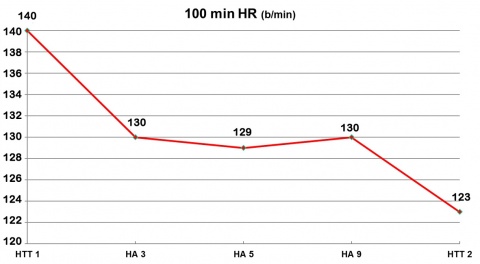
The traditional hallmarks for a standard time course of HA are reduced thermal and cardiovascular strain manifested primarily as a reduced heart rate and core temperature and secondarily as an attenuation of the symptoms of heat strain and increased sweat production during a given level of exercise-heat stress [16, 17, 20, 21, 29, 33, 34]. HA-induced physiological adaptations generally occur in two phases: cardiovascular changes including plasma volume expansion, increased stroke volume, reduced heart rate, and autonomic nervous system habituation which redirects cardiac output to skin capillary beds, occur in the first 6 to 7 days; sweat changes including increased sweat rate, earlier onset of sweating, and decreased sweat electrolyte losses, usually occur after the fifth day [3, 10, 12, 20, 23]. Complete or full HA is achieved when all responses have reached a plateau, or the point where 95 % of the adaptation has occurred [3]. More specifically, the following HA-induced changes in physiological responses to a given exercise-heat stress with range of HA days required for that adaptation to plateau at approximately 95 % of its maximal response:
These adaptations are for healthy well-nourished, adequately hydrated subjects. The result of the above physiological adaptations is an improved transfer of heat from the body’s core to the skin and from the skin to the environment [3, 29].
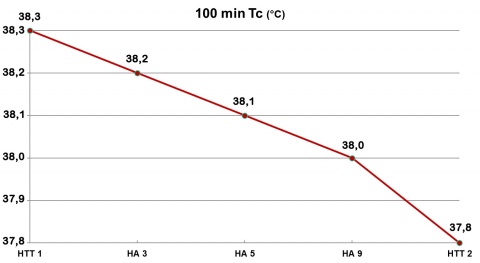
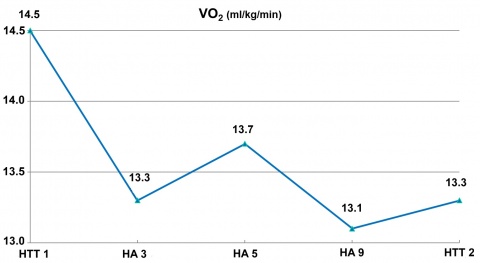
HA data from a US Air Force (USAF) thermal stress research protocol [6, 30] demonstrate the above. Eight males (age 27.2 ± 4.8 yrs, mass 72.3 ± 8.4 kg, maximum oxygen uptake (VO2 max) 55.1 ± 6.6 ml O2 kg-1 min-1) completed heat tolerance tests (HTT 1 and HTT 2) before and after nine consecutive days of HA. Both the HTT and HA trials consisted of 100 minutes walks at 25 % VO2 max in hot-humid conditions 43.1 ± 0.1 °C DB (dry bulb), 50.0 ± 0.1 % relative humidity (RH), 33 mmHg vapor pressure (VP). We measured rectal temperature (Tc), heart rate (HR), VO2, and sweat sensitivity (SS) during the HTTs and HA trials 3, 5 and 9. Subjects achieved HA as indicated by HTT 1 vs HTT 2 (see figures 1, 2 and 3).
During military training and operations, the combined effects of metabolic heat production and environmental heat stress can result in significant heat strain. Protective clothing and equipment can further restrict heat loss (clothing insulation and evaporative resistance). Without sufficient heat dissipation, hyperthermia (elevated core and skin temperatures) can threaten mission success by impairing task performance and increasing the risk of heat illness.
If heat dissipation is attenuated or completely shut off, is there any value in HA? Some claim that HA is not useful in the military setting. YAMAZAKI [35] states, “HA improves endurance work performance in the heat and thermal comfort at a given work rate. In workers wearing personal protective suits in hot environments, however, little psychophysiological benefit is received from short-term exercise training and/or heat acclimation because of the ineffectiveness of sweating for heat dissipation and the aggravation of thermal discomfort with the accumulation of sweat within the suit.” However, HA affects both sides of the heat balance picture. The cardiovascular and thermoregulatory adaptations listed above increase heat dissipation, gains that are attenuated or eliminated in the military clothing/equipment microenvironment, but HA also elicits metabolic adaptations that attenuate heat generation, namely a reduction in exercise metabolic rate for a given work load, i.e., improved exercise economy (run and walk) or efficiency (cycling) [3, 11, 29]. This adaptation is quite viable for military training and operations as a reduction in exercise metabolic rate (lower oxygen uptake, a lower VO2 submax, at the same workrate) is a non-sweating means of affecting heat balance [18, 22, 36].
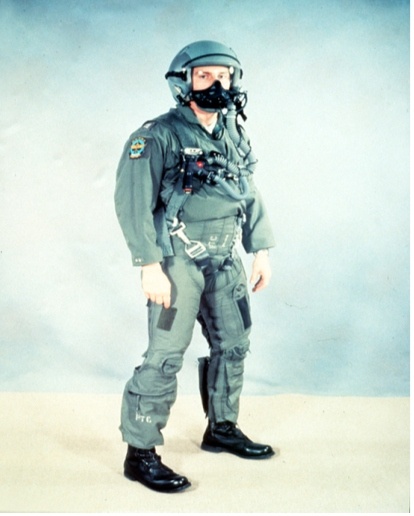
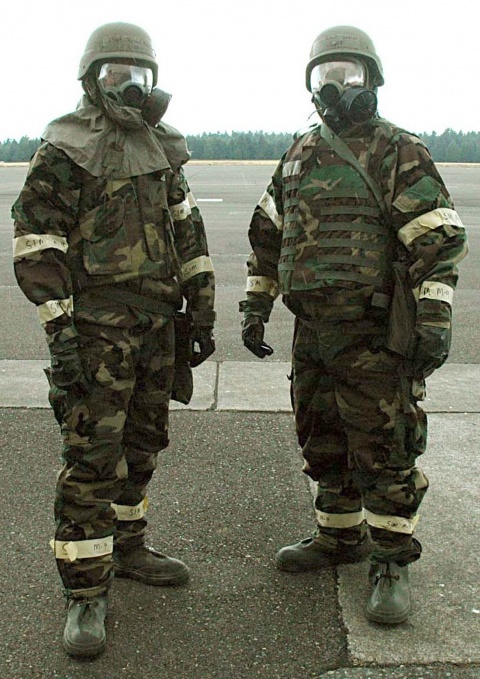
Our USAF data demonstrate the import of a HA-induced reduction in heat generation when one must don military gear that impairs heat dissipation, primarily evaporative heat loss. We studied the effects of heat acclimation and short-term physical training on exercise-heat tolerance in men wearing protective clothing. The USAF Chemical Defense Ensemble (CDE) consists of a two piece chemical protective overgarment, butyl rubber hood, mask, and gloves worn over standard military fatigues/air battle uniform [30]; clo value = 2.5 (see figure 6).
The CDE impedes heat dissipation and its bulk (7.5 kg) decreases movement efficiency [25]. Numerous studies have documented the physiological strain imposed by CDE; higher Tc, Tsk, SS, HR, VO2, and sweat rate [4, 30, 7, 15, 28]. Mechanical modifications, e.g., water or air cooled vests, and modeling / prediction studies have been accomplished; however, can we alter physiological capability? We conducted exercise trials on 16 males (mean ± SD: age 26.3 ± 5.0 yrs, body mass 73.4 ± 7.6 kg, VO2 max 54.8 ± 6.2 mlO2 kg-1 min-1, body composition 14.3 ± 4.4 % fat, body surface area 1.90 ± 0.11 m2) wearing the CDE prior to and after 10 days of HA or 10 days of short term physical training (STPT), n = 8 each group [5].
Trial pattern:
CDE Test 1 (Pre) –> HA Treatment or STPT Treatment –> CDE Test 2 (Post)
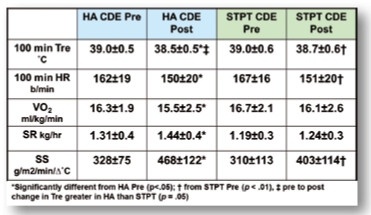
We measured core and skin temperature, heart rate, VO2, cutaneous blood flow, thyroxine, lactate, sweat rate – corrected for fluid intake, urine output, respiratory water loss, and carbon weight loss, and fluid intake – measured aliquots of 6 % carbohydrate beverage at 3, 20, 32, 47, 63, and 80 minutes to replace 100 % of sweat production during all tests and trials. HA treatment was ten consecutive days of walking 100 minutes per day at 25 % VO2 max in 43.3 °C DB / 50 % RH, 33 mmHg VP, 1.8 m/s air speed. Subjects wore shorts and footwear and had full fluid replacement each trial. STPT treatment was ten consecutive days of 40 minutes treadmill interval running per day at 85 %-105 % VO2 max in 22 °C DB / 45 – 55 % RH, 9.9 mmHg VP, 1.8 m/s air speed. Subjects wore shorts and footwear. Pre- and post-CDE Tests were 100 minutes walks at 25 % VO2 max in 30 °C DB / 50 % RH (elicited 32 mmHg VP in the CDE micro-environment), 1.8 m/s air speed. The hot-humid HA treatment environment matched the VP in the CDE microenvironment. STPT increased VO2 max (8 %), and both HA (6 %) and STPT (10 %) increased plasma volume. CDE 1 vs CDE 2 test responses are shown in Table 1.
In conclusion, HA increased exercise-heat tolerance in the CDE by increasing heat dissipation (limited amount in microenvironment), but primarily by reducing metabolic heat production. Although STPT had lesser effects than HA, it still provides an alternative procedure for improving work performance in the CDE.
Scientific basis exists for employing HA in the military environment as HA attenuates thermoregulatory strain and risk of heat illness when wearing military gear, and additional data show that HA enhances human endurance performance. LORENZO, et al. [13] studied the impact of HA on endurance cycling performance in both cool and hot environments and found that HA improved VO2 max and time trial performance 5 % to 8 % as compared to matched controls. They concluded, “HA provides more substantial environmental specific improvements in aerobic performance than altitude acclimation.” Therefore, we recommend HA as a relatively low cost means for military personnel performing physical tasks in hot, thermo-neutral or cool environments when wearing military gear that inhibits heat dissipation.
Applied Physiology Recommendations
USAF Instruction 48 – 151, Thermal Injury Prevention Program, is available as a helpful reference for applied physiology use in military organizations. Finally, the application of science-based HA principles is an example of the key role military scientific organizations should perform by underpinning military training and operational policies and procedures with scientific basis and rationale. This will at times require solid leadership and communication to overcome the inertia inherent to military traditional-historical patterns that are not necessarily optimal. These patterns typically have been in place across military generations, but often lack a sound basis for application in training and operations.
The views expressed in this article are those of the author, and do not necessarily reflect official United States Government, Department of Defense, or Air Force positions or policies.
Author
Dr. Neal Baumgartner
United States Air Force Exercise Science Unit
Joint Base Randolph, Texas 78150
United States of America
E-Mail: [email protected]
Datum: 27.10.2018