The Bundeswehr Medical Service Command (KdoGesVersBw) unites human medicine, pharmacy, veterinary medicine, and dentistry under one command. As the Bundeswehr’s specialist medical command with troop command responsibility, it integrates outpatient care, medical education and research, health protection, and clinical care into a single, cohesive structure. Through its unique matrix organization, the KdoGesVersBw combines medical expertise with operational leadership, ensuring comprehensive medical support and readiness across all levels of military operations.
To begin with, Herr Surgeon General, what are the core tasks of the Medical Service Command?
At the Bundeswehr Medical Service Command (KdoGesVersBw), aspects of human medicine, pharmacy, veterinary medicine, and dentistry are all equally represented. We are the Bundeswehr’s specialist command with simultaneous troop command responsibility for all centrally consolidated medical forces.
As a troop command authority, we lead three pillars:
The first is outpatient care, including all medical facilities for primary care of soldiers, as well as Role 1 medical support forces deployed in operational areas.
The second pillar is the Bundeswehr Medical Academy (SanAkBw), which serves as a training, research, and teaching institution, and as the bearer of capabilities for health protection.
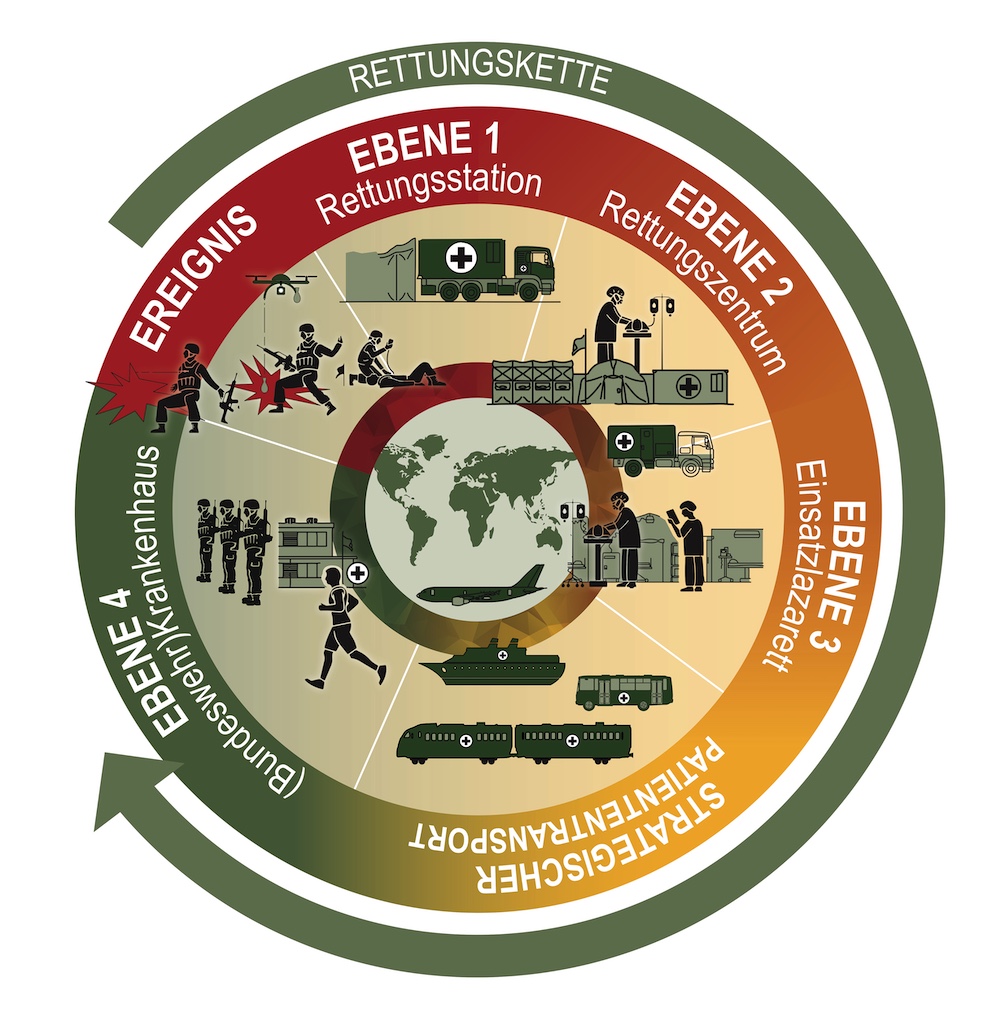
The third pillar comprises clinical care, bringing together all medical units and Bundeswehr hospitals to provide Role 2, 3, and 4 elements of the medical evacuation chain.
We exercise both professional and troop command responsibility through the KdoGesVersBw staff. Troop command tasks—personnel management, materiel management, and operational planning—are handled through the classical staff functional areas. In addition, there are profession-specific responsibilities reflecting the four licensed medical disciplines. Overall, this is organized in a matrix structure closely linked with the Support Command in Bonn, which functions as a Medical Component Command—analogous to Land, Air, and Maritime Component Commands—to integrate medical leadership and expertise into the operational and strategic levels.
And your personal focus as commander? Is there something where you would say: “This is where I am currently driving change”?
Like the Bundeswehr as a whole, the medical service is transitioning to new framework conditions—moving away from nearly 30 years of international crisis management back to the core mission of national and collective defense. This involves providing extraterritorial force elements within alliances.
One of my main priorities is reorganizing the medical service around this core mission, including adjustments to the medical care strategy. At the same time, we must expand medical personnel—a major challenge in terms of training and organization. Capacities must be created in infrastructure, training systems, and attractiveness as an employer. These are my priorities for the next 24 months.
The KdoGesVersBw was established on April 1, 2025, and had to report full operational capability by September 30. This was largely a formal declaration. We operate under the principle “fight tonight” and must absorb increases in personnel and materiel while simultaneously developing and implementing the organizational structure. From 2027 onward, further iterations may be necessary—signs indicate that conflicts along the Eastern European border could intensify.
Are there particular challenges? For example, is recruiting personnel still difficult—keyword “new military service”?
We are fortunate to offer highly attractive professional training programs. The healthcare market still provides opportunities, but the situation is becoming more difficult. Finding suitable personnel for healthcare professions amid demographic change affects the entire healthcare sector. However, we still have good applicant numbers, which we must utilize.
The problem in recent years was structural—we lacked the appropriate number of positions. The Bundeswehr’s 2010 structural decision imposed strict personnel ceilings that constrained us. Without allocated positions and budgetary resources, we were unable to recruit qualified personnel, even when we wanted to.
This has changed significantly over the past year. Now we must capitalize on the favorable situation and bring personnel into training. We also need to develop training concepts to make optimal use of the new military service model.
Speaking of education—you mentioned the Medical Academy as the middle pillar. How is it structured?
The SanAkBw is more than just a school. On one hand, it is a medical training institution offering courses for medical personnel across all career paths and specialized training programs. In the future, we will establish a training center analogous to those of the Army, Air Force, and Navy.
The second component is military medical research and teaching in the classical sense. This includes a newly established master’s program in “Digitalization and Healthcare” in cooperation with the Bundeswehr University Munich, specifically for trained medical personnel. Digitalization is one of the key enabling processes we must advance.
The SanAkBw also oversees departmental research institutes: microbiology, pharmacology and toxicology, radiobiology, and preventive medicine. These conduct specialized research for Germany and its armed forces. Medical CBRN defense is a major focus, where we are globally leading.
In crisis situations, the federal government relies on this expertise—as seen during the COVID-19 pandemic, when the Institute of Microbiology served as a reference laboratory for pathogen detection.
And in the field of research?
Two interesting projects:
The first concerns lung ventilation. The lungs play a critical role in respiratory infections, as demonstrated during COVID-19. We are working on improving detection capabilities.
The second focuses on sepsis, a systemic infection. Despite top-level intensive care, sepsis still has about a 30% mortality rate in Germany. We are researching whether early-detectable biomarkers can help intervene before full onset.
A long-term goal is to restore the reputation of military medical research, which was highly regarded before 1945 but later fell behind. To this end, we have established two research networks—North and South—and civilian universities are showing increasing interest in cooperation.
Mit WhatsApp immer auf dem neuesten Stand bleiben!